
Centrifugal pump full load torque
Definition and calculation of pump full load torque
Follow us on Twitter 
Question, remark ? Contact us at contact@myengineeringtools.com
| Section summary |
|---|
| 1. Definition |
| 2. Full load torque calculation |
| 3. Full load torque calculator |
1. Definition
What is the full load torque ?
2. Full load torque calculation
How to calculate a centrifugal pump full load torque ?
The full load torque of a centrifugal pump can be calculated the following way, it gives the relation in between the pump torque and the pump speed :3. Full load torque free calculator
Warning : this calculator is provided to illustrate the concepts mentioned in this webpage, it is not intended for detail design. It is not a commercial product, no guarantee is given on the results. Please consult a reputable designer for all detail design you may need.
3.1 Excel calculator
You can download the Excel file here : download
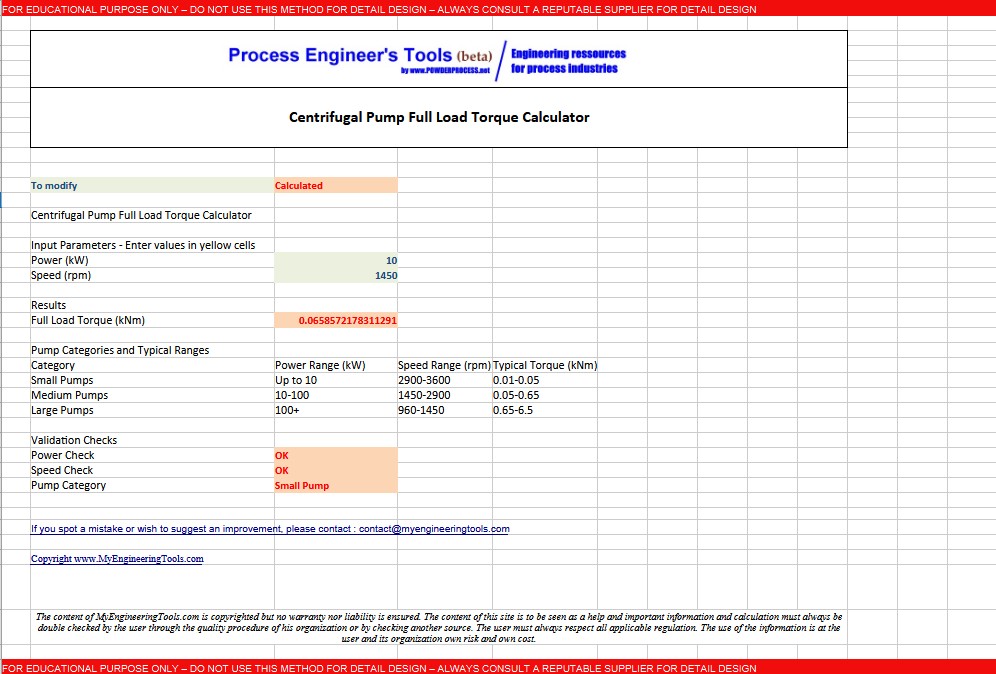
3.2 Online calculator
Centrifugal Pump Full Load Torque Calculator
Typical Ranges and Industry Examples
Small Pumps (up to 10 kW)
- Speed: 2900-3600 rpm
- Typical torque: 0.01-0.05 kNm
- Applications: Water circulation, small chemical transfer
Medium Pumps (10-100 kW)
- Speed: 1450-2900 rpm
- Typical torque: 0.05-0.65 kNm
- Applications: Process pumps, cooling water systems
Large Pumps (100+ kW)
- Speed: 960-1450 rpm
- Typical torque: 0.65-6.5 kNm
- Applications: Heavy industrial processes, large water treatment
Technical Information
The full load torque (T) is calculated using:
T = 30.P / (π.n)
Where:
- T = Torque in kilonewton-meters (kNm)
- P = Power in kilowatts (kW)
- n = Speed in revolutions per minute (rpm)
- π = 3.14159
Practical Plant Engineering Rules of Thumb & Safety Limits
- Motor sizing margin: Select the driver motor at least 10–15 % above the pump absorbed power at the design duty point to cover viscosity, wear-ring clearance growth and off-design operation.
- Starting torque: Centrifugal pumps are low-inertia, low-starting-torque machines. Direct-on-line starting torque is typically 20–30 % of full load torque, so the coupling and shaft must be rated for the motor's locked-rotor torque, not the pump's full load torque.
- Coupling rating: Size the flexible coupling for at least 1.5 × the pump full load torque to absorb transients and misalignment.
- Speed selection: Prefer 1450 rpm (4-pole) or 960 rpm (6-pole) for medium and large pumps to reduce wear and NPSH problems; reserve 2900 rpm (2-pole) for small, high-head duties.
- Torque–speed relation: For a fixed power, torque is inversely proportional to speed. Doubling speed halves the torque but quadruples the hydraulic power demand (affinity laws).
- Failure modes: Insufficient motor torque causes stall and winding overheating; excessive torque causes shaft fatigue, coupling shear and bearing overload. Always verify the motor's breakdown torque exceeds the pump's maximum torque demand.
- Verification: Cross-check the calculated torque against the pump vendor curve and the motor nameplate before procurement.
FAQ: Centrifugal Pump Full Load Torque
1. What is full load torque in centrifugal pumps?
Full load torque is the torque applied by a centrifugal pump when operating at full load. It is calculated based on the pump's power and speed.
2. How is full load torque calculated?
Full load torque \( T \) is calculated using the formula: \[ T = \frac{30 \times P}{\pi \times n} \] Where: - \( T \) = Torque (kNm) - \( P \) = Pump power (kW) - \( n \) = Pump speed (rpm) - \( \pi \) = 3.14159.
3. What are typical torque ranges for small pumps?
Small pumps (up to 10 kW) typically operate at speeds of 2900-3600 rpm with torques ranging from 0.01 to 0.05 kNm. They are used in applications like water circulation and small chemical transfer.
4. What are typical torque ranges for medium pumps?
Medium pumps (10-100 kW) operate at speeds of 1450-2900 rpm with torques ranging from 0.05 to 0.65 kNm. They are used in process pumps and cooling water systems.
5. What are typical torque ranges for large pumps?
Large pumps (100+ kW) operate at speeds of 960-1450 rpm with torques ranging from 0.65 to 6.5 kNm. They are used in heavy industrial processes and large water treatment systems.
6. Why is full load torque important in pump design?
Full load torque is critical for selecting the appropriate motor and ensuring the pump operates efficiently without overloading the drive system.
7. How does pump speed affect torque?
Torque is inversely proportional to speed. As pump speed increases, torque decreases, and vice versa, assuming power remains constant.
8. What happens if the motor torque is insufficient for the pump?
If the motor torque is insufficient, the pump may not reach full speed or may stall under load, leading to reduced performance or damage.
9. Can full load torque be measured directly?
Yes, torque can be measured directly using torque meters or indirectly calculated using the formula based on power and speed.
10. Are there tools available to calculate full load torque?
Yes, our website offers a free Excel calculator and an Excel tool to estimate centrifugal pump full load torque.
Top 5 Most Popular