
Free Radical Polymerization : reaction rate calculation
How to calculate the reaction rate of a polymerization reaction ?
Follow us on Twitter 
Question, remark ? Contact us at contact@myengineeringtools.com
1. Polymerization reaction
2. Initiation rate
3. Propagation rate
4. Termination rate
5. Polymerization rate
6. Interactive Online Kinetic Calculator
7. Plant Engineering Rules of Thumb & Safety
⚡ Interactive Free Radical Polymerization Calculator
Calculation Summary & Kinetics Output
Polymerization reactions appear often complex, how to calculate their reaction rate in the case of a free radical polymerization ?
1. Polymerization reaction
In radical polymerization, the following reactions happen :
- Initiation
- Propagation
- Termination
There are also transfer reactions but they are not discussed in this paragraph, therefore now they are considered negligible.
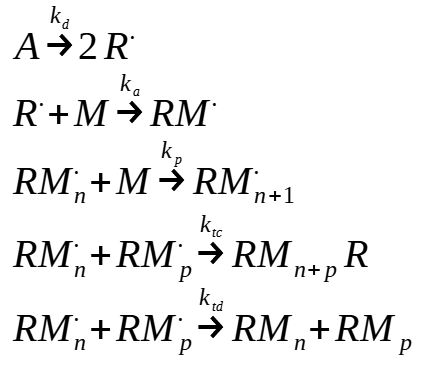
In order to calculate the overall polymerization reaction, it is necessary to express the reaction rate of these different reactions.
2. Initiation rate
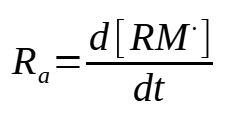
The rate of initiation is equal to the rate of production of radical \(RM^\bullet\):
The rate of production of \(RM^\bullet\) is equal to the rate of consumption of free radical \(R^\bullet\).
The equations below are given in rate of production:
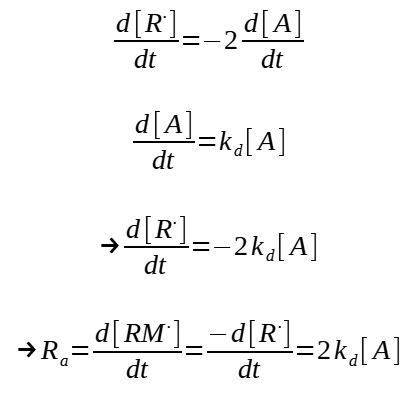
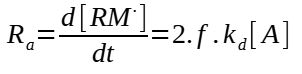
This expression needs however to be modified to take into consideration that only some of the initiator leads to an actual initiation and then a polymerization reaction. Considering \(f\) as being the efficiency of the initiator (\(f = 0.3\) to \(0.8\)), the rate of initiation is then :
3. Propagation rate
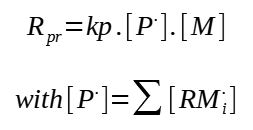
The propagation is actually made of all the successive reactions that allow to add one monomer to the polymer chain.
Considering that the rate constant \(k_p\) of all the reactions is the same, the propagation rate can be written the following way :
4. Termination rate
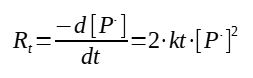
The termination reactions are in between 2 radicals, to give "dead" chains, which means that they do not have a radical anymore and thus cannot grow anymore. There are 2 reactions of termination, either 2 radicals give 2 polymer chains (dismutation) or give one polymer chain (recombination), however from a kinetic point of view, the reaction rate is expressed the same as 2 radicals react with each other :
5. Polymerization rate
The polymerization rate is defined as the rate of consumption of the monomer :
\[ R_p = -\frac{d[M]}{dt} \]There are 2 reactions involving the monomer : the initiation and the propagation, and both are consuming the monomer.

If we consider we are producing long chains of polymers, which is normally the case, the expression can be simplified by neglecting the initiation rate, which will be very small compared to all the other propagation reactions.
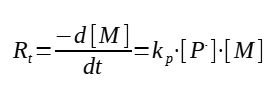
This general expression is however not very practical, indeed, how to determine the concentration in growing chains ?
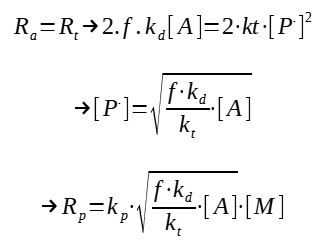
The following hypothesis can be made : the propagation is very quick, thus the number of radicals is not changing, which means that the initiation rate is equal to the termination rate (Quasi-Steady State Approximation, QSSA) :
6. Typical Kinetic Constant Values
Values depend strongly on the monomer, initiator, and temperature. For example (at 60 °C):
-
Styrene:
- \(k_p \approx 3 \times 10^2 \text{ L mol}^{-1}\text{s}^{-1}\)
- \(k_t \approx 1 \times 10^7 \text{ L mol}^{-1}\text{s}^{-1}\)
-
Methyl methacrylate (MMA):
- \(k_p \approx 2 \times 10^3 \text{ L mol}^{-1}\text{s}^{-1}\)
- \(k_t \approx 2 \times 10^7 \text{ L mol}^{-1}\text{s}^{-1}\)
-
Initiator (benzoyl peroxide, BPO):
- \(k_d \approx 1 \times 10^{-5} \text{ s}^{-1}\)
- Efficiency \(f \approx 0.5\)
These values provide a starting point for quick estimates.
7. Worked Example – Styrene with BPO
Let us calculate the polymerization rate at 60 °C:
- \([M] = 5 \text{ mol/L}\)
- \([I] = [A] = 0.01 \text{ mol/L}\)
- \(k_p = 300 \text{ L mol}^{-1}\text{s}^{-1}\)
- \(k_t = 1 \times 10^7 \text{ L mol}^{-1}\text{s}^{-1}\)
- \(k_d = 1 \times 10^{-5} \text{ s}^{-1}\)
- \(f = 0.5\)
Step 1 – Radical concentration:
\[ [R^\bullet] = [P^\bullet] = \sqrt{\frac{0.5 \times 1 \times 10^{-5} \times 0.01}{1 \times 10^7}} = 7.1 \times 10^{-8} \text{ mol/L} \]Step 2 – Rate of polymerization:
\[ R_p = 300 \times 5 \times 7.1 \times 10^{-8} = 1.1 \times 10^{-4} \text{ mol/L}\cdot\text{s} \]Thus, about 0.1 mmol of styrene polymerizes per liter per second under these conditions.
8. Degree of Polymerization and Molecular Weight
The average kinetic chain length (\(\bar{X}_n\)) can be related to the ratio of propagation to termination rates:
\[ \bar{X}_n = \frac{R_p}{R_t} \]In practice, molecular weights are in the range of \(10^4 - 10^6 \text{ g/mol}\) depending on the conditions. Process engineers often adjust initiator concentration and temperature to target the desired \(M_n\) (number-average molar mass).
💡 Plant Engineering Rules of Thumb & Safety Limits
- Exothermic Heat Removal: Free radical polymerizations are strongly exothermic (\(\Delta H_{rxn} \approx -70 \text{ to } -100 \text{ kJ/mol}\)). High heat generation rates demand robust reactor jacket cooling, emergency quenching, or solvent reflux loops to prevent thermal runaway.
- Trommsdorff (Gel) Effect Autoacceleration: At conversions above ~20–40%, solution viscosity increases sharply, severely restricting radical diffusion. This drops \(k_t\) by several orders of magnitude while \(k_p\) remains relatively constant, causing active radical concentration \([P^\bullet]\) and heat release rate to surge uncontrollably.
- Initiator Half-Life Selection: Select initiators whose half-life (\(t_{1/2} = \ln(2)/k_d\)) matches the target reactor residence time. Typically, \(t_{1/2}\) should be 10% to 50% of total batch residence time at target reaction temperature.
- Viscosity & Mixing Limits: As conversion exceeds 60–80%, batch agitators face severe torque limits and flow stagnation, creating hot spots. Continuous Stirred Tank Reactors (CSTR) or Loop Reactors are preferred for narrow molecular weight distribution.