
Sound velocity definition and calculation for an ideal gas
Follow us on Twitter

Question, remark? Contact us at contact@myengineeringtools.com
| Section Summary |
|---|
| 1. Definition of the Sound Velocity |
| 2. How to Calculate the Sound Velocity |
| 3. References of Speed of Sound in Air |
| 4. Interactive Online & Excel Sound Velocity Tool |
1. Definition of the sound velocity in an ideal gas
The sound velocity, sometimes also called the speed of sound, is the distance traveled by a sound wave in a gas during a unit of time. It is generally expressed in m/s (or ft/s in US Customary units) and is used in many process engineering calculations, specifically those involving compressible fluid flows and Mach number analysis.
2. How to calculate the sound velocity for an ideal gas
The following fundamental formula is used to calculate the speed of sound in an ideal gas:
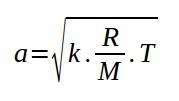
Where:
- \( a \) = speed of sound in m/s
- \( k \) = specific heat ratio or isentropic coefficient (\( C_p / C_v \)), dimensionless
- \( R \) = perfect gas constant = 8314 J/(kmol·K)
- \( T \) = gas temperature in Kelvin (K)
- \( M \) = molecular weight in g/mol (or kg/kmol)
💡 Plant Engineering Rules of Thumb & Safety Limits
- Acoustic Piping Velocity Limit: To prevent severe high-frequency acoustic vibration, fatigue, and damage to pipe walls, line velocities should be restricted to < Mach 0.3 during normal continuous process operations.
- Choked Flow (Mach 1.0): In safety relief valves, control valves, or orifice plates, gas velocity cannot exceed Mach 1.0. At Mach 1.0, downstream pressure changes cannot propagate upstream, resulting in choked flow.
- Ideal Gas Law Deviation: At high operating pressures (\( P > 10 \text{ bar} \)) or temperatures close to the gas dewpoint, the ideal gas assumption deviates significantly. Real speed of sound can be 5% to 25% lower than predicted by this formula, requiring real gas equation of state calculations (e.g. Peng-Robinson).
3. References of speed of sound for common fluids
| Gas | Temperature (°C) | Speed of Sound (m/s) | Speed of Sound (ft/s) |
|---|---|---|---|
| Air | 20 °C | 343 m/s | 1125 ft/s |
| Air | 100 °C | 386 m/s | 1266 ft/s |
| Air | 150 °C | 410 m/s | 1345 ft/s |
4. Interactive Online & Excel Sound Velocity Tool
Use the professional-grade interactive calculator below to instantly solve for gas sound velocity in both metric and imperial systems. Download the spreadsheet version below to integrate within your pipeline design files.
Excel Spreadsheet Downloader: Link to Excel Calculation Tool

Ideal Gas Sonic Flow Theory
The speed of sound in an ideal gas depends solely on its thermodynamic absolute temperature and specific gas components. It is physically derived by considering an adiabatic compression wave propagating through fluid elements. Because acoustic cycles occur rapidly, heat transfer between fluid layers does not have sufficient time to occur. This justifies the application of the isentropic relationship:
Taking the square root of this partial derivative yields the classic expression utilized in compressors, turbines, and high-velocity piping designs:
Where \( R_s = \frac{R}{M} \) is the specific gas constant.
FAQ: Sound Velocity in Ideal Gases
1. What is sound velocity in an ideal gas?
Sound velocity (or speed of sound) is the physical rate of propagation of pressure waves through a compressible gas medium, dependent heavily on absolute temperature and the specific gas species properties.
2. How is sound velocity calculated for an ideal gas?
The speed of sound (\( a \)) in an ideal gas is calculated using: \[ a = \sqrt{k \times \frac{R}{M} \times T} \] Where: \( k \) is the specific heat ratio, \( R \) is the universal gas constant, \( T \) is absolute temperature, and \( M \) is the gas molecular weight.
3. What are typical sound velocities in air at different temperatures?
Typical sound velocities in dry air include: 343 m/s at 20°C, 386 m/s at 100°C, and 410 m/s at 150°C.
4. Can the formula be used for gases other than air?
Yes, this formula holds true for any ideal gas, provided the correct specific heat ratio (\( k \)) and molecular weight (\( M \)) are supplied for the fluid composition.